Autocephalous Greekorthodox Church of Cyprus V Goldberg and Feldman Fine Arts Inc
Abstruse
An abstruse is non available for this content and so a preview has been provided. Please use the Get admission link in a higher place for data on how to access this content.
References
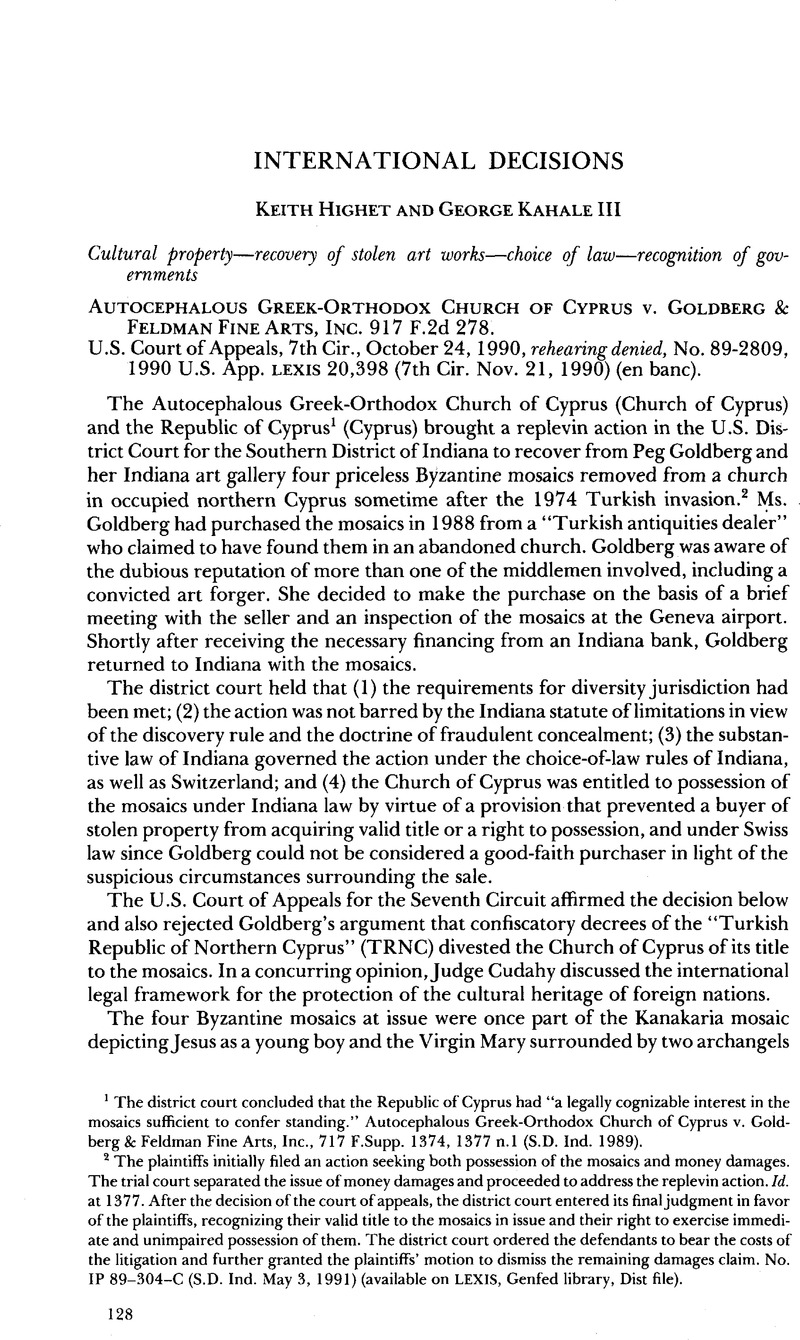
1 The district court concluded that the Republic of Republic of cyprus had "a legally cognizable involvement in the mosaics sufficient to confer standing." Autocephalous Greek-Orthodox Church of Cyprus v. Goldberg & Feldman Fine Arts, Inc., 717 F.Supp. 1374, 1377 n.ane (Due south.D. Ind. 1989).
2 The plaintiffs initially filed an action seeking both possession of the mosaics and money damages. The trial court separated the issue of money damages and proceeded to address the replevin action. Id. at 1377. Afterwards the decision of the court of appeals, the commune court entered its final judgment in favor of the plaintiffs, recognizing their valid championship to the mosaics in outcome and their right to do firsthand and unimpaired possession of them. The district court ordered the defendants to bear the costs of the litigation and farther granted the plaintiffs' movement to dismiss the remaining damages merits. No. IP 89–304–C (Due south.D. Ind. May 3, 1991) (available on LEXIS, Genfed library, Dist file).
6 The district court concluded that the asking by "the Turkish Republic of Northern Cyprus ('TRNC') to intervene as a plaintiff for the purpose of recovering possession of the mosaics … strongly indicates that it, too, never authorized the removal or sale of the Kanakaria mosaics." 717 F.Supp. at 1379 north.3. The court denied this request, stating that "to permit the Turkish Republic of Northern Republic of cyprus to arbitrate in this instance would create the incongruous result of having the Judicial Branch implicitly recognize that entity as a legitimate government in the face of explicit nonrecognition by the Executive Co-operative." Autocephalous Greek-Orthodox Church building of Cyprus v. Goldberg & Feldman Fine Arts, Inc., No. IP 89–304–C (S.D. Ind. May 31, 1989) (memorandum entry supplementing guild of May xxx, 1989, denying the motility for intervention).
vii 917 F.2d at 285 (quoting U.s. v. Wong Kim Ark, 169 U.Due south. 649, 668 (1898)).
eight The courtroom considered the following factors: the recognition of the Autocephalous Church and its correct to regulate its own internal affairs and to own and register property under the Constitution and laws of the Democracy of Cyprus.
9 The Indiana Supreme Court departed from the traditional lex loci delicti commissi rule in tort cases in Hubbard Mfg. Co. v. Greeson, 515 Due north.E.second 1071 (Ind. 1987). The courtroom noted that the to a higher place decision declared that "[w]hen the place of the tort bears little connection to the legal action, … the following factors should exist considered: i) the place where the acquit causing the injury occurred; 2) the residence or identify of business concern of the parties; and three) the identify where the relationship is centered." 917 F.2d at 286–87 (quoting id. at 1073–74 and citing Restatement (Second) of Conflict of Laws §145(ii) (1971)).
10 The defendants, those who financed and effected the transfer of the mosaics and those who held the principal monetary interest in the mosaics at the time of the proceeding, were all Indiana citizens; the money used for the purchase came from an Indiana banking concern; the turn a profit-sharing agreement for the eventual auction of the mosaics stipulated that Indiana law would apply; and the mosaics were located in Indiana at the fourth dimension of the proceeding. 917 F.2d at 287.
eleven Ind. Code §34-1-ii-one (1982).
13 The discovery rule for determining the accrual of a cause of action was initially developed to address the difficulties plaintiffs oftentimes encountered when "in actions for medical malpractice and in products liability actions involving toxic drugs or chemicals, the statute has run before the plaintiff discovers that he has suffered injury, and sometimes even earlier the plaintiff himself has suffered the injury." The discovery dominion has been extended by judicial decisions and legislative enactments to "a miscellany of negligence and other tort actions." W. Prosser & P. Keeton, The Police of Torts §30 at 165, 167 (5th ed. 1984) (citations omitted).
14 917 F.2nd at 289. The court of appeals referred to a determination of the New Jersey Supreme Court in which the discovery rule was used to decide accrual of a replevin action brought by Georgia O'Keeffe in 1976 to recover possession of 3 paintings stolen in 1946 from a gallery operated by her late married man, Alfred Steiglitz. In concluding that the discovery dominion applies to an activity for replevin of a painting, the New Jersey Supreme Court stated that "O'Keeffe'southward cause of activity accrued when she showtime knew, or reasonably should have known through the exercise of due diligence, of the cause of activeness, including the identity of the possessor of the paintings." O'Keeffe v. Snyder, 83 Northward.J. 478, 493, 416 A.2d 862, 870 (1980).
16 The court noted the observation by the district court that the due diligence decision is "highly "fact-sensitive and must be decided on a case-by-case basis.'" Id. (quoting 717 F.Supp. at 1389).
17 Id. at 290. Cyprus had contacted the leading museums and Byzantine scholars throughout the earth, international auction houses (including Christie's and Sotheby'due south) and the media, as well as several organizations in add-on to UNESCO (e.grand., the International Council of Museums, the International Quango of Monuments and Sites, and the Council of Europe), to request assistance in recovering the Kanakaria mosaic. Every bit stated by the court of appeals, "The overall strategy behind these efforts was to go word to the experts and scholars who would probably be involved in any ultimate sale of the mosaics." Id. at 281.
xviii The commune court had concluded that the mosaics, once severed from the apse of the Kanakaria Church, could exist the subject of a replevin activity to recover possession of personal belongings. 717 F.Supp. at 1396.
19 917 F.second at 290 (quoting 25 Indiana Constabulary Encyclopedia, Replevin §§1, two, 11 (Westward 1960) (citations omitted)).
20 The court of appeals noted the district courtroom's determination that the Church of Republic of cyprus also had a superior title to the mosaics under Swiss constabulary, "because Goldberg could not claim valid title under the Swiss 'good faith purchasers' notion having only made a cursory inquiry into the suspicious circum stances surrounding the sale of the mosaics." Id. at 291.
22 Id. (citations omitted).
23 Gauge Noland in the commune court, to whom the decrees were presented at the later stages of the trial, considered them irrelevant. On entreatment, Goldberg requested the courtroom to "award these decrees under the notion that in some instances courts in the U.s.a. can give effect to the acts of nonrecognized only 'de facto' regimes if the acts relate to purely local matters." 917 F.second at 291 & due north. 14.
24 By these decrees, the TFSC had confiscated "all movable property within the boundaries of the TFSC abandoned by its owner because of the owner'due south 'divergence' from northern Republic of cyprus," as well every bit all religious buildings and antiquities and all movable antiquities. Id. at 291–92.
25 Id. at 292 (citing, inter alia, Us five. Belmont, 301 U.S. 324, 328 (1937)).
26 In instance of secession, the validity of the acts of the seceding government depends on its ultimate success in beingness recognized as an independent nation. This concept was developed in post-Civil War cases. Id. at 293.
28 Nov. 14, 1970, 823 UNTS 231, reprinted in x ILM 289 (1971) (entered into force for the United States December. 2, 1983). See besides the implementing legislation enacted in 1983, Convention on Cultural Holding Implementation Human activity, Pub. Fifty. No. 97-446, tit. III, 96 Stat. 2351, nineteen U.Due south.C. §§2601–2613 (1988).
29 May 14, 1954, 249 UNTS 215. The difficulties involved in locating and recovering the cultural heritage of a nation plundered in time of war has been sadly demonstrated by the recent gulf crisis. State of kuwait has requested assistance from UNESCO "to assist foreclose the possible illegal sale of tens of thousands of pieces of art pilfered during the Gulf State of war." UNESCO Press Release No. OPI/NYO/91/6C (June 10, 1990).
31 For the concluding two reports, run across UN Docs. A/44/485 (1989) and A/46/497 (1991). The unesco Intergovernmental Committee for Promoting the Return of Cultural Property to its Countries of Origin or its Restitution in Case of Illicit Cribbing assists states engaged in bilateral negotiations concerning the return of cultural belongings, every bit discussed in the reports referred to higher up.
Source: https://www.cambridge.org/core/journals/american-journal-of-international-law/article/autocephalous-greekorthodox-church-of-cyprus-v-goldberg-feldman-fine-arts-inc/783EB0DC8D496429ACFF06716CBC800E
0 Response to "Autocephalous Greekorthodox Church of Cyprus V Goldberg and Feldman Fine Arts Inc"
Post a Comment